
BAcC response to The Economist article ‘Does acupuncture work?’
By Ian Appleyard, BAcC Research & Policy Manager https://acupuncture.org.uk/news/bacc-response-to-the-economist-article-does-acupuncture-work/
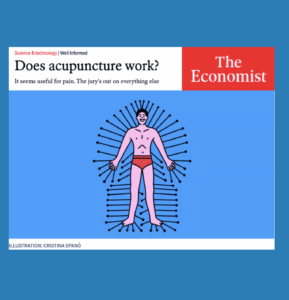
Last weekend The Economist published an article and column by Health & Science writer Tim Cross asking ‘Does acupuncture work?’ BAcC Research and Policy Manager Ian Appleyard has responded to the interesting topics raised in the article, which you can read here https://www.economist.com/science-and-technology/2026/05/01/does-acupuncture-work
Chronic pain – the evidence is strong
The Economist article correctly leads with the most rigorous evidence on acupuncture for any condition, the individual patient data meta-analysis on acupuncture for chronic pain [1]. This study demonstrates that acupuncture is effective compared to usual care, is not a placebo, and the benefits last for at least a year. In 2000, the evidence was not strong. Over the last 20 years high-quality large scale clinical trials have been conducted, especially in Germany, that form the basis of the Vickers et al study.
Next steps should be:
- Establish services within the NHS to provide acupuncture for the conditions where there is strong evidence, ie chronic pain, and provide a drug-free option that aligns with key objectives of the prescribing and patient choice.
- Properly fund research into acupuncture for other conditions.
Can the result be explained as a placebo?
The article suggests that the results may be attributable the ‘astonishing power to reduce pain when it is believed that a genuine intervention is being conducted’. And Tim Cross’s blog poses the question, ‘might it just be reversion to the mean’? Both legitimate questions.
However, the purpose of a placebo-controlled trial is to control for placebo effects. In other words, the participants in the placebo group believed they are receiving the genuine intervention. Therefore, a difference between groups cannot be explained by the ‘power of the brain’ in this way. Similarly, the groups were randomised and trials have a parallel design, which means a difference between groups cannot be explained by reversion to the mean.
Edzard Ernst is quoted as saying “we don’t need a placebo to generate placebo effects”. This is correct. Placebo effects are generated in equal measure by acupuncture and sham acupuncture. This is a principle of the study design. It is also why the authors of the individual patient data meta-analysis concluded that acupuncture is not a placebo – because the study demonstrates a clear difference between acupuncture and sham acupuncture. Both groups benefited from any placebo effects.
The Economist article cites a 2020 study in JAMA which found no difference in pain scores between acupuncture and sham. Actually, this study compares electroacupuncture with sham electro acupuncture. However, the most important issue is that it is a single study with only 121 participants. There are 7,237 participants in the Vickers study comparing acupuncture with sham. These are not comparable studies.
Does qi exist?
There is a common misunderstanding about qi. It is a complex concept.
Qi has been translated using ancient Greek terms such as pneuma and has also been described as life-force, vitality or energy. In Chinese, qi has lots of different meanings depending on the context. It is a commonly used word within day-to-day language as well as an integral part of Chinese philosophy.
In truth, it is probably best not to try and translate the term at all. Instead, a few examples can give a sense of the meaning of qi in Chinese medicine. In Chinese, anger is shengqi 生气 – which literally means ‘growing’ qi. This is what is depicted by cartoonists to illustrate a character getting angry with the head and upper body swelling and the face growing red. Disheartened or discouraged is xieqi 泄气 – which could be literally translated as ‘let out’ or ‘leak’ qi. This is like the English expression to feel ‘deflated’.
So, qi can be seen as an observable aggregate effect of multiple physiological changes, which we experience as anger or happiness or disappointment. It does not have to be a ‘life force’, as yet undiscovered by science. Simply saying qi does not exist is akin to saying anger or joy do not exist.
Evidence on acupuncture for other conditions
The Economist also highlights that the benefits of acupuncture are less clear for other conditions: i.e. beyond pain management. The article cites a summary paper of systematic reviews that found ‘acupuncture could reduce post-operative nausea about as well as some antiemetics. It also found benefits for migraines and tension headaches, cancer-related fatigue, female infertility…’.
Because of the challenges of developing placebo acupuncture procedures, the interpretation of the results remains controversial [2, 3]. Therefore, it is right that potential conflicts of interest are clearly stated and The Economist notes the authors of the summary review are acupuncturists. However, the US Department of Veterans Affairs (VA) also published a summary review in JAMA which found evidence of positive effect for a number conditions, but more research is required [4].
Conclusion
Despite the relative lack of funding, the evidence base for acupuncture continues to strengthen leading to recommendations in clinical guidelines across the globe [5, 6].
For example:
NICE recommend acupuncture for headaches [7]
NICE recommend acupuncture for primary chronic pain [8]
SIGN recommends acupuncture for osteoarthritis and back pain [9]
The American Society of Clinical Oncology recommends acupuncture for symptoms experienced by people with cancer [10]
The American Society of Clinical Oncology recommends acupuncture for symptoms experienced by people with breast cancer [11]
There is strong evidence that acupuncture is effective for chronic pain, it should be utilised more widely within the NHS.
References
1. Vickers, A.J., et al., Acupuncture for Chronic Pain: Update of an Individual Patient Data Meta-Analysis. The journal of pain : official journal of the American Pain Society, 2018. 19(5): p. 455-474.
2. Appleyard, I., Acupuncture out, dogma in: The U.K. National Institute for Health and Care Excellence guideline for osteoarthritis 2022. European Journal of Integrative Medicine, 2023. 61: p. 102262.
3. Appleyard, I., T. Lundeberg, and N. Robinson, Should systematic reviews assess the risk of bias from sham–placebo acupuncture control procedures? European Journal of Integrative Medicine, 2014. 6(2): p. 234-243.
4. Allen, J., et al., Use of Acupuncture for Adult Health Conditions, 2013 to 2021: A Systematic Review. JAMA Network Open, 2022. 5(11): p. e2243665-e2243665.
5. Tang, X., et al., Characteristics and quality of clinical practice guidelines addressing acupuncture interventions: a systematic survey of 133 guidelines and 433 acupuncture recommendations. BMJ Open, 2022. 12(2): p. e058834.
6. Birch, S., et al., Overview of Treatment Guidelines and Clinical Practical Guidelines That Recommend the Use of Acupuncture: A Bibliometric Analysis. J Altern Complement Med, 2018. 24(8): p. 752-769.
7. NICE, Headaches in over 12s: diagnosis and management, in Clinical guideline CG150. 2021, National Institute for Health and Care Excellence.
8. NICE, Chronic pain (primary and secondary) in over 16s: assessment of all chronic pain and management of chronic primary pain, in NICE Guideline NG193. 2021, National Institute for Health and Care Excellence.
9. SIGN, Management of chronic pain SIGN 136, in A national clinical guideline. 2019, Scottish Intercollegiate Guidelines Network.
10. Mao, J.J., et al., Integrative Medicine for Pain Management in Oncology: Society for Integrative Oncology–ASCO Guideline. Journal of Clinical Oncology, 2022. 40(34): p. 3998-4024.
11. Cardoso, F., et al., 6th and 7th International consensus guidelines for the management of advanced breast cancer (ABC guidelines 6 and 7). The Breast, 2024. 76.
Traditional Acupuncture Treatment
For Traditional Acupuncture Treatment, which has worked in my practice on many patients for 31 years, contact Hannah Charles Lic Ac Member of the British Acupuncture Council (MBAcC) at: https://www.southwellacupuncture.co.uk/contact/
Hannah Charles is a founder member of the British Acupuncture Council (BAcC)
The BAcC is an advocate for traditional acupuncture professionals and maintains the highest professional standards to protect the general public. BAcC members are registered on an accredited register, regulated and approved by the Professional Standards Authority for Health & Social Care (PSA). For More information, see the website: https://acupuncture.org.uk/