UK Healthy Life Expectancy drops to 61: Is acupuncture a solution to the healthcare crisis?
Blog from The British Acupuncture Council Blog By Maggie Kelly, BAcC PR & Communications Officer
Acupuncture Treatment
For Traditional Acupuncture Treatment to find your way through the present Health Crisis, to help you balance, strengthen and calm your system, contact Hannah Charles Lic Ac Member of the British Acupuncture Council (MBAcC) at: https://www.southwellacupuncture.co.uk/contact/

UK Healthy Life Expectancy (HLE) drops to 61 years, prompting concern that ‘the UK’s health is going backwards’. Can acupuncture help reverse the trend?
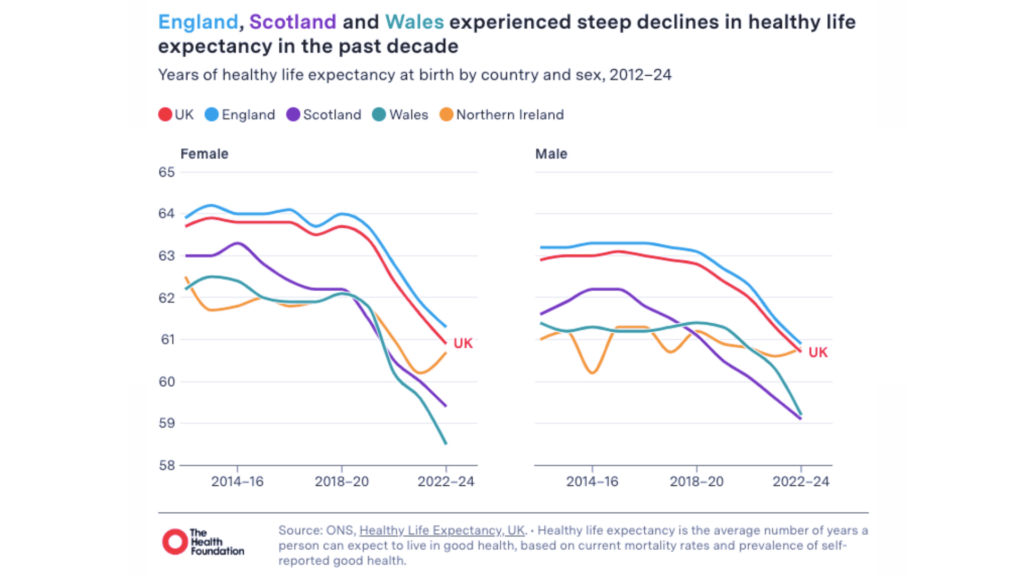
A new report by the Health Foundation, based on figures from the Office of National Statistics, signals an alarming decline in the years UK citizens can expect to live in good health; a figure termed ‘Healthy Life Expectancy’ or HLE. This decline has seen the UK fall to second lowest of the world’s wealthiest nations, with only the United States reporting a lower HLE. While overall life expectancy has remained stable the diverging HLE metric, based on self-reported health and mortality data, presents a grim outlook. The average person now enters a state of ‘poor health’ at age 61 – more than half a decade before they reach the state pension age.
Regional Disparities
Regional disparities further illustrate the severity of this crisis. London is the only region with improved HLE and much of the country faces a decline driven by poverty, substandard housing, rising obesity and the long-term impact of the COVID-19 pandemic.
Demographic/Region – Healthy Life Expectancy (approx. years)
UK National Average – 61 years
Wealthiest 10% of Areas ~20 years longer than the poorest
Richmond (London) – men 69 years
Richmond (London) – women 70 years
Blackpool – men 51 years
Hartlepool – women 51 years
The reality that a man in Blackpool may face chronic ill-health nearly two decades earlier than a man in Richmond highlights the need for community-level clinical interventions that address the root causes of disease.
The ‘retirement gap’ – economic and social implications
The ‘retirement gap’ represents a significant economic threat with HLE falling below the state pension age of 66 or 67 in more than 90% of the UK. The nation faces a future where the final years of a person’s working life are limited by chronic illness.
Economic and social pressures identified by the Health Foundation
- Workforce depletion: high volumes of the workforce are driven into economic inactivity due to long-term illness.
- Youth obstruction: mental health issues prevent younger people from completing training or entering the workforce.
- Systemic inequality: deprived communities spend significantly more years in poor health, deepening existing social chasms.
Can traditional acupuncture help reverse the trend?
As healthcare providers grapple with this stark realisation, groundbreaking research from the University of Southampton indicates that traditional acupuncturists are already delivering the intensive lifestyle support required to reverse this trend. The Study, published in BMC Complementary Medicine and Therapies: https://link.springer.com/article/10.1186/s12906-022-03719-6 reveals that over 90% of BAcC practitioners provide specific lifestyle guidance to patients with chronic conditions, positioning the holistic acupuncture model as a vital, ready-made infrastructure for addressing the UK’s declining health trajectory.
This shift from reactive treatment to proactive behavioural intervention is now a strategic necessity, moving beyond national statistical decline toward the specific and proven solutions identified in the BAcC’s research.
BAcC’s Acupuncture Awareness Week
As demonstrated by the BAcC’s Acupuncture Awareness Week 2025 campaign, traditional acupuncture can provide an existing, high-contact model of care that fulfils the urgent demand for preventative healthcare and helps alleviate the overwhelming pressure faced by the UK’s National Health Service. Therefore, a BAcC registered traditional acupuncturist’s unique status as Professional Standards Authority (PSA) accredited means that work within NHS settings is possible.
Integrated Acupuncture
The BAcC currently helps facilitate several NHS integrated acupuncture projects across the UK, including flagship mental health clinics in Inner Gloucester and a pain clinic in Derbyshire Dales. Last November saw the publication of a healthcare referral guide ‘Collaborate with Confidence ‘ aimed at Healthcare providers,and designed to make referring patients to a BAcC and PSA regulated acupuncturist a simpler process: https://acupuncture.org.uk/news/how-do-traditional-acupuncturists-support-patients-to-make-lifestyle-changes/#:~:text=lifestyle%20changes?%20-%20BAcC-,How%20do%20traditional%20acupuncturists%20support%20patients%20to%20make%20lifestyle%20changes,alcohol%20consumption%20and%20sleep%20habits.
BAcC acupuncturists gold-standard
“While these latest statistics show a concerning decrease in healthy life expectancy in the UK, it makes us even more resolute about highlighting the impact that acupuncture can have on the nation’s physical and mental health. BAcC acupuncturists gold-standard degree level (or equivalent) training and PSA accreditation means that we work within NHS settings alongside regulated health professionals such as physiotherapists. In a healthcare landscape where patients in economically challenged areas have demonstrably poorer health outcomes, equal access to this traditional and highly effective holistic medicine is of vital importance to help redress the balance and better serve those communities.” Alex Jacobs, CEO, British Acupuncture Council
Acupuncture is a catalyst for lifestyle change
Groundbreaking Research led by Jonquil Pinto MBAcC at the University of Southampton – see link above provides a strategic blueprint for meeting public health targets. This study, the first to analyse a representative sample of BAcC Members, finds that traditional acupuncturists are acting as primary facilitators for lifestyle modifications. By addressing diet, physical activity and sleep, the primary drivers of poor health outcomes globally, practitioners bridge the gap between traditional symptom management and modern public healthcare needs.
Core findings from the Pinto/Southampton University study
Treatment impact: 57.7% of traditional acupuncturists offered specific lifestyle change support during their most recent session.
Chronic condition success: 91.7% of practitioners provide lifestyle support ‘always or most of the time’ for chronic cases.
Acute care support: 67.9% of practitioners integrate lifestyle guidance into acute treatments.
Achieving behavioural transformation
Effective behaviour change is the next frontier in healthcare policy. While the UK’s primary care networks and local GP’s often lack the time to influence deeply ingrained habits, the acupuncture model utilises three primary predictors for successful support: patient receptivity, the likelihood of improvement through lifestyle change and the strength of the therapeutic relationship.
This model facilitates transformation through:
- Extended consultation time - allowing for the in-depth dialogue required to address behavioural drivers.
- High level of contact - building the rapport necessary to sustain difficult lifestyle shifts.
- The holistic mandate - addresses ‘wider determinants of health’ views symptoms in the context of the patient’s environment.
Prevention First
This ‘prevention first’ approach, advocated by leaders like Dr Layla McCay of the NHS Alliance, offers a clinical pathway to intervene before health declines lead to further burden on public healthcare systems and the UK workforce.
“The UK has the highest levels of obesity in western Europe and there has been a surge in mental ill health, especially among young people. This had created a significant economic cost, with poor health driving people out of the workforce and locking young people out of education, employment and training.” Andrew Mooney, Principal Data Analyst, The Health Foundation
“The figures are a stark reminder of how deeply health inequalities are affecting people’s lives… the answer has to be prevention first, tackling the wider determinants of health, strengthening community-based care and improving access to support closer to home.” Dr Layla McCay, Policy Director, NHS Alliance
Clinical Evidence
The BAcC / University of Southampton study provides the clinical evidence required to act on these warnings. By integrating the holistic infrastructure of BAcC registered practitioners, the UK can move toward restoring a healthy life expectancy that finally exceeds the retirement age.
If you would like to try acupuncture
The BAcC and the Pinto Study. The British Acupuncture Council (BAcC) is the UK’s leading self-regulatory body for traditional acupuncturists. The research ‘Acupuncture and the Promotion of Healthy Lifestyle Behaviours’ was conducted by Jonquil Pinto at the University of Southampton and was part-funded by the BAcC. The study involved a survey of over 350 practitioners and was published in BMC Complementary Medicine and Therapies. It highlights the critical role of holistic care in addressing national public health challenges, including diet, exercise and sleep hygiene.https://acupuncture.org.uk/find-an-acupuncturist/
Media contact: Maggie Kelly, BAcC PR & Communications Officer
Email: m.kelly@acupuncture.org.uk
Traditional Acupuncture Treatment
For Traditional Acupuncture Treatment to find your way through the present Health Crisis, to balance, strengthen and calm your system, contact Hannah Charles Lic Ac Member of the British Acupuncture Council (MBAcC) at: https://www.southwellacupuncture.co.uk/contact/
Hannah Charles is a founder member of the British Acupuncture Council (BAcC)
The BAcC is an advocate for traditional acupuncture professionals and maintains the highest professional standards to protect the general public. BAcC members are registered on an accredited register, regulated and approved by the Professional Standards Authority for Health & Social Care (PSA). For More information, see the website:https://acupuncture.org.uk/